

It’s about the first 60 seconds.
Higher education campuses are built to be open.
Open dialogue.
Open Access.
Open movement across classrooms, residence halls, labs, libraries, and public spaces.
But in a crisis, this openness can quickly become a vulnerability, because here’s the uncomfortable truth: most violent critical incidents are over in less than six minutes.
The national average law enforcement response time is between five and nine.
This means outcomes are often shaped before sirens can even be heard. And in those first five minutes? Your faculty, staff, and students are the first responders.
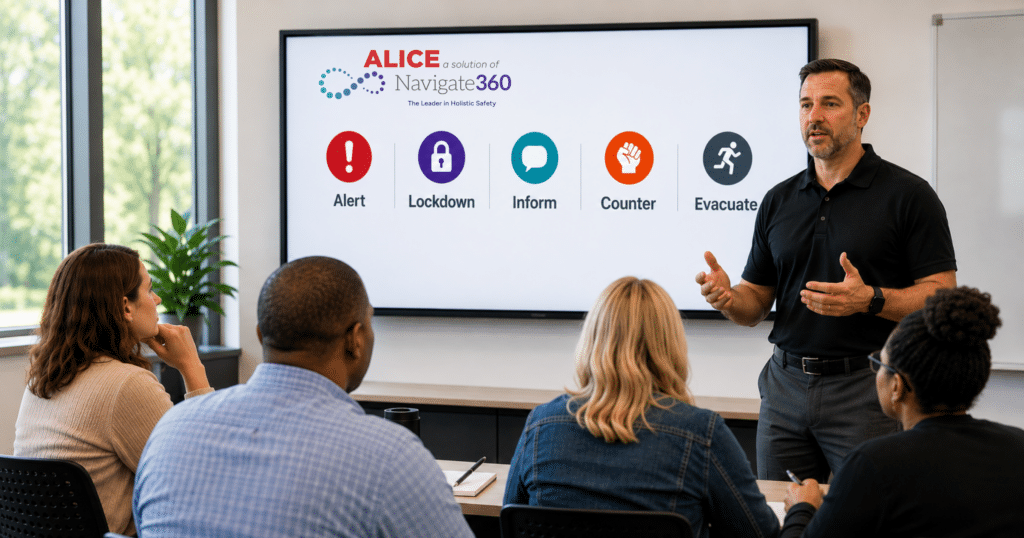
In a recent webinar, Training that Works: Active Shooter Response for Campuses, George Hunter, Director of Training for ALICE at Navigate360, walked through what preparedness truly looks like in higher education and why traditional, one-size-fits-all strategies aren’t enough.
As George said during the webinar, “The true first emergency responders are the people who find themselves in harm’s way at that moment.”
National organizations, like the American College Health Association, have identified gun violence as a growing public health concern affecting campus communities across the U.S.
Here’s what campus leaders need to understand.
A Policy Won’t Walk Into a Classroom
During the webinar, George made one thing clear. When it’s time to perform, the time to prepare has passed.
In a real emergency, people don’t rise to the level of a policy. They default to their level of training.
If training says, “Wait. Lockdown. Follow instructions,” then that’s what they’ll try, even if it doesn’t fit the moment. This is why lockdown cannot be a stand-alone plan.
George pointed to decades of research and real incidents to reinforce this point: lockdown can be a strong strategy in the right circumstances, but on a modern campus, it cannot be the only option.
Higher education is not just one building with one hallway. One response doesn’t fit every space.
Safety training for colleges must reflect the complexity of the campus itself.
Seconds Decide Outcomes
Previous incidents have taught us that when alerts are delayed or individuals are confused about what to do next, lives are lost.
Information spreads unevenly. Some hear it, some don’t.
Some people freeze. Others spring into action.
Effective safety training for college campuses should teach people to:
- Recognize danger immediately
- Accept the alert rather than rationalizing it away
- Communicate real-time information
- Choose the safest available option, whether it’s lockdown, evacuation, or another protective action
As George explained, “Once you recognize the alert, you’re now participating in your own survival.”
The goal isn’t to turn educators into first responders. It’s about eliminating paralysis and encouraging people to act in the face of violence.
People Will Do What They Practice
Stress changes the brain.
In high-adrenaline moments, people don’t carefully analyze options. They don’t reread procedures in their mind. They either act, flee, or freeze.
They react, and reaction is built on repetition.
During the webinar, George used a familiar example to describe this phenomenon. Most adults remember being taught to “stop, drop, and roll” as children, even decades later.
If faculty and staff have only participated in passive, compliance-based drills, that is what they’ll fall back on. But, if they’ve practiced recognizing threats, making decisions, and adapting to changing conditions, their response becomes faster and more confident.
Training has to move beyond theory. It must include group discussion, scenario thinking, and realistic decision-making, so individuals can connect the dots before they’re forced to in real life.
Because in a crisis, hesitation isn’t neutral. It costs time, and time matters.
Communication During an Emergency Must Be Quick & Clear
You’ve seen it with your students: in today’s digital age, when something happens on campus, information travels fast. But it’s not always accurate.
One person hears a noise.
Another sees someone running.
Someone else receives a vague message.
Confusion can spread just as quickly as fear. Clear, real-time communication is one of the strongest protective factors a campus can have. Faculty and staff should not only know how to receive alerts, but how to initiate them as well. Leadership must ensure that systems are tested, operational, and built for clarity.
Using plain language is important. The ability to provide location details and immediate updates matter.
While many institutions rely on coded systems, George cautioned that they can create confusion, especially on college campuses with visitors, contractors, vendors, and new students who may not know what those codes mean.
As he explained during training sessions, “Issuing alerts in plain language ensures people can understand and process the information immediately. Not everyone on campus knows the codes, but everyone understands plain language.”
Some leaders worry that plain language might create panic or alert the intruder.
George addressed that directly:
“The sound of gunfire is going to create fear on its own. A code isn’t preventing that. And the intruder is already there.”
In emergencies, silence creates chaos. Clear communication creates direction.
Training Must Match the Environment
A residence hall doesn’t function like a laboratory.
A lecture hall doesn’t operate like an athletic arena.
An open quad is not a classroom.
So why do many institutions apply identical training across every environment?
Effective safety training for colleges acknowledges the vast environmental differences on their campus. It prepares people to think about:
- Where entrances and exits are located
- What physical barriers exist
- How crowds behave in their specific setting
- What immediate options make sense in that space
During the webinar, George encouraged participants to mentally walk through their own buildings and ask: “What would you do right now?”
A faculty member pictures their own classrooms. An RA imagines their dorm floor. An administrator visualizes their office. Preparation becomes powerful when it feels practical.
Preparation Must Be Ongoing—Not Just Annual
Training done once and never revisited fades quickly.
Skills weaken. Confidence erodes. Details blur.
Sustainable safety training for colleges includes:
- Annual or bi-annual reinforcement
- After-action reviews following drills
- Honest evaluation of what worked and what didn’t
- Adjustments based on lessons learned
Preparedness should evolve as campuses evolve, as buildings change, as student populations shift, and as new technologies are introduced.
Violence preparedness is not a one-time initiative. It is an ongoing strategy.
A Practical Way to Evaluate Your Campus
If you’re responsible for campus safety, you may think to yourself, “We already have training.”
But would it translate under pressure?
To help institutions assess their readiness, our Campus Violence Readiness Checklist for Higher Education walks through key areas including leadership alignment, training consistency, communication flow, environmental planning, culture, and continuous improvement.
It’s not a replacement for training.
It’s a starting point for stronger conversations.
Safety Is Not One-Size-Fits-All
As concerns around gun violence in schools continue to amplify, the conversation around school drills must evolve. Checking a box is not enough. Students deserve training that prepares them without harming their well-being. Staff members deserve clear guidance. Families deserve transparency
Lockdown-only drills are no longer sufficient on their own.
Multi-option, trauma-informed strategies, like what ALICE Training® teaches, provides schools with a better path forward, one that supports safety, confidence, and collaboration, so students can attend school ready to learn.
Watch the Webinar
Preparedness is defined in the first few minutes of a crisis.
Watch the on-demand webinar with George Hunter, Director of ALICE Training®, to see how safety training for colleges prepares students, faculty, and staff to recognize threats, communicate clearly, and act when seconds matter.

“In the twenty three years I have been a Police Officer, I have received close to 100 certificates. The ALICE Training I received from you is one of the best courses of instruction I have ever taken.”
About ALICE Training®
For over 20 years, ALICE Active Shooter Response Training has led the way in empowering schools, workplaces, and communities with proactive response strategies to improve safety and save lives.

George Hunter
George retired July 2015 from the Warren County Sheriff’s Office in Ohio after 27 plus years of service. During his time at the Sheriff’s Office, he served in many capacities including the Corrections Division, Patrol Division, Field Training Officer, Training Division, Enforcement Supervision, Court Services Division, and he served as a Command Staff member at the Sheriff’s Office from 2005 – 2015. George has served on the Ohio Judicial Conference Court Security Review Committee and the Ohio Supreme Court Security Review Committee.
George is a graduate from the Northwestern University Traffic Institute School of Police Staff and Command, The Ohio Law Enforcement Foundation’s Police Executive Leadership College and the Federal Bureau of Investigations National Academy 247th Session.
Related Posts
-

The Safe Option Can Change in Seconds: What to Do in an Active Shooter Situation
Learn what to do in an active shooter situation, why the safest response can change quickly, and how options-based training helps people assess and adapt.
Read More
-
School Safety Strategies for Catholic Schools
Explore Catholic school safety strategies that strengthen emergency preparedness, improve response training, and build a culture of readiness.
Read More
-
Does ALICE Training® Work? What the Research Says
Does ALICE Training work? See what peer-reviewed research reveals about survival rates, response times, and trauma-informed active shooter training.
Read More


Discover the Freedom of Empowerment
Prepare your people for the worst case scenario with the best possible training. Reach out today for a quote on in-person training sessions, eLearning options or a blend of the two – and discover the freedom of knowing you’ve done everything you could to prevent tragedy.