
Key Takeaways
- Catholic school safety requires more than lockdown-only plans. Options-based training gives students and staff multiple ways to respond during a violent critical incident.
- Effective Catholic school safety starts with a culture of readiness. Age-appropriate training helps school leaders, staff, families, and students understand how to respond in an emergency.
- Simple safety measures can strengthen school emergency preparedness. Knowing evacuation routes, planning barricades, locking classroom doors, and practicing situational awareness can improve readiness.
As school safety expert, Dr. Allison Willemin put it, “Hope alone is not a good strategy.”
School safety is no longer a public-school-only concern. Gun-related incidents have nearly doubled as a share of school violence in just two years—growing from 17.9% to 30.8%, making it clear—school safety is not a public-school-only concern.
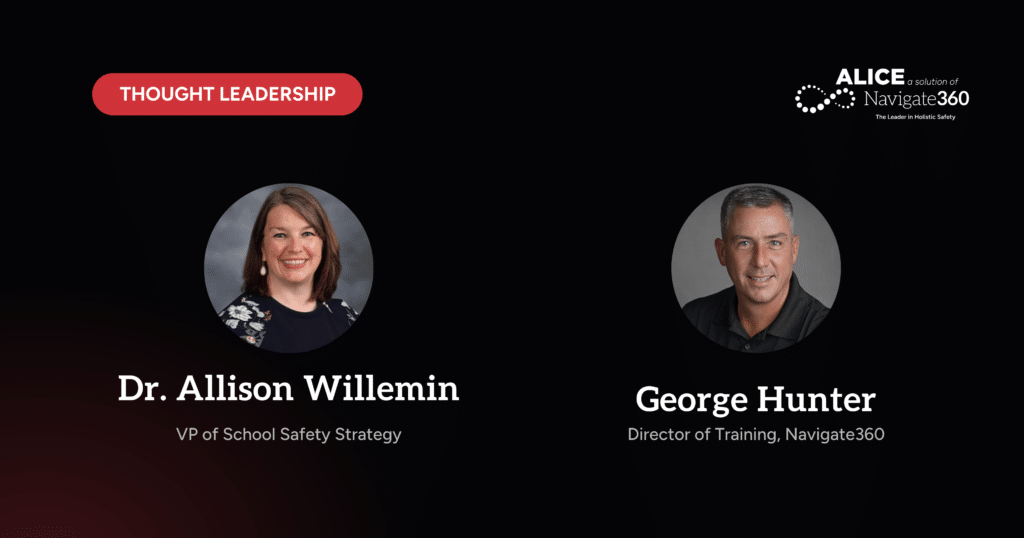
In Preparing Your Catholic School Community for the Unthinkable, Dr. Willemin—VP of School Safety Strategy at Navigate360—and George Hunter, Director of ALICE Training and a 27-year law enforcement veteran, explored what true school readiness looks like in action.
They explained why lockdown-only plans leave gaps, how to train your entire community (from the young to the elderly), and what emergency planning looks like in a faith-based setting.
For Catholic schools, safety and security go beyond the classroom to the parish, the open-door church, and Mass during the week. Hunter explained that situational awareness is a life skill, one that helps students and staff feel safe: during worship, in class, or walking down the street.
As George Hunter says, “You’re gonna react to the level of your training.”
Lockdown-Only Leaves Dangerous Gaps
The Grand Blanc Michigan church shooting proved lockdown-only plans leave dangerous gaps. The incident involved arson, requiring people to exit the building, something a barricaded would’ve blocked.
Instead, an options-based, trauma-informed framework equips everyone with a plan they can deploy during any violent critical incident.
Starkly, only 18% of teachers feel confident their training would minimize loss of life, and roughly half of students share that same uncertainty.
The right training closes that gap—that’s where ALICE shines.
So, what does ALICE teach?
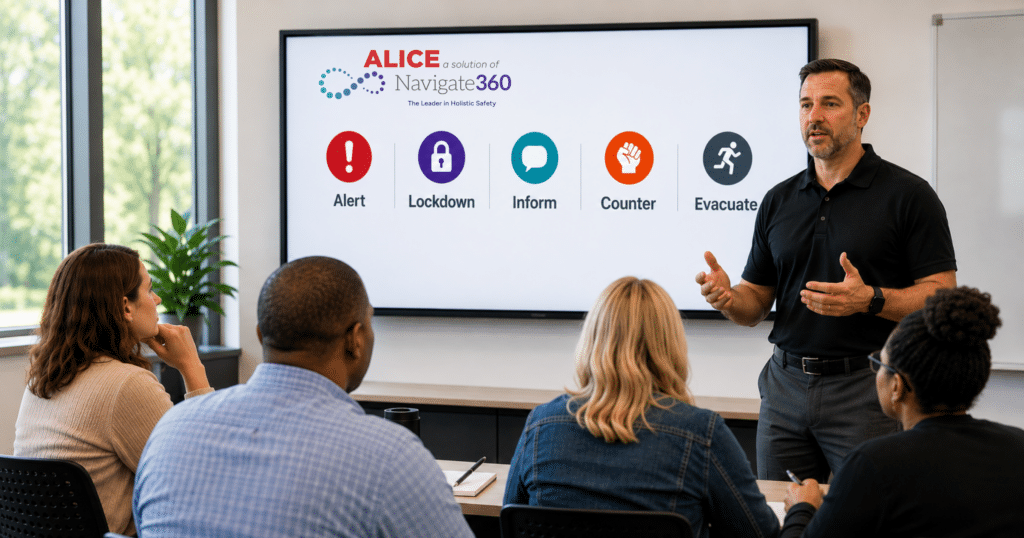
ALICE—short for Alert, Lockdown, Inform, Counter, and Evacuate—is an options-based framework, not a rigid checklist. These five responses work in order: alert others to danger, lock down and barricade when you can’t leave, inform with real-time details, counter as a last resort using noise and movement (not fighting), and evacuate to a rally point when it’s safe.
Just as important, ALICE is trauma-informed. That means ALICE recognizes that students and staff bring different experiences into their learning environments and delivers that preparedness in a way that builds confidence instead of fear.
In practice, that means it accounts for the different experiences students and staff bring to their learning environments and prepares them in a way that builds confidence instead of fear.
That attention to mental health precisely separates genuine readiness from a compliance checkbox.
Readiness is a Culture, Not a Single Drill
As George Hunter makes clear, readiness isn’t a single drill. It’s a culture. He recommends rolling training out in layers: first school and parish leaders, then teachers, parents, and finally students, each at an age-appropriate level.
Because Catholic school families are often the same faces you see on Sunday, that shared trust makes buy-in easier. When everyone is on the same page, an announced drill builds real readiness and confidence.
The Four Steps Towards Preparedness Every Classroom Can Take Today
As Dr. Willemin put it, “We want everyone to go home at the end of every day.”
Here are four things you can implement today:
- Learn your nearest exits before you need them
- Be mindful of your position while teaching—never turn your back to the door
- Preplan your barricade and determine which furniture you can move
- Keep classroom doors locked during class hours. It’s a simple and low-cost line of defense
Today, more than 37 states require active-shooter response training, many including Catholic and non-public schools. Compliance is only the floor. The schools that are truly prepared are the ones who ask hard questions first.
As Hunter said, “I’m the director of training, but I’m also a dad and a husband. If there’s a better program I could teach my own family—my wife and my five kids—I’d do it tomorrow. I’ve not found anything better.”
Build Readiness Before the First Bell
This webinar was hosted in partnership with the National Catholic Educational Association (NCEA).
Watch Preparing Your Catholic School Community for the Unthinkable and start building readiness today.
“In the twenty three years I have been a Police Officer, I have received close to 100 certificates. The ALICE Training I received from you is one of the best courses of instruction I have ever taken.”
About ALICE Training®
For over 20 years, ALICE Active Shooter Response Training has led the way in empowering schools, workplaces, and communities with proactive response strategies to improve safety and save lives.

The ALICE Training® Editorial Team
The ALICE Training® Editorial Team is a passionate group of professionals dedicated to sharing accurate, actionable, and forward‑thinking guidance on active shooter response and overall safety preparedness. Our team draws on diverse expertise in education, law enforcement, emergency management, and technology, giving us a well‑rounded perspective on the challenges schools, workplaces, and communities face every day.
With extensive firsthand experience in implementing the ALICE strategies, conducting safety drills, and integrating proven response protocols, our writers bring practical insight to every piece of content. We collaborate with leading safety experts and trainers to deliver reliable, easy‑to‑understand information that empowers you to build safer, more prepared environments.
Related Posts
-

The Safe Option Can Change in Seconds: What to Do in an Active Shooter Situation
Learn what to do in an active shooter situation, why the safest response can change quickly, and how options-based training helps people assess and adapt.
Read More
-
Does ALICE Training® Work? What the Research Says
Does ALICE Training work? See what peer-reviewed research reveals about survival rates, response times, and trauma-informed active shooter training.
Read More
-

Safety Training for Colleges: Preparing Campuses for the First Critical Minutes
Discover key strategies for implementing safety training for colleges to enhance emergency readiness and protect the campus community.
Read More


Discover the Freedom of Empowerment
Prepare your people for the worst case scenario with the best possible training. Reach out today for a quote on in-person training sessions, eLearning options or a blend of the two – and discover the freedom of knowing you’ve done everything you could to prevent tragedy.