

Key Takeaways
- School shooting survivor stories can reveal gaps in preparedness. Meredith Arnold’s experience highlights why educators need response options and the confidence to act.
- ALICE Training® helps educators make informed decisions based on the circumstances they face during a violent critical incident.
- Trauma-informed training supports confidence without relying on fear. For Arnold, that approach helped her share her experience and prepare others.
On November 8, 2005, Meredith Arnold was an assistant principal at Campbell County High School in Tennessee when a student opened fire in the main office area. One colleague lost their life. Two others were wounded.
Arnold continued her career in education, eventually becoming a director of schools. For years after the experience, she worked to make every school she served safer.
“I do not want any other human to have to experience what we did,” she said.
During a conversation with George Hunter, Director of Training at Navigate360, Arnold explained how that commitment brought her to ALICE Training®—and how the experience helped her share her story and prepare others.
School shooting survivor stories often share a common thread: the event ends, but the impact doesn’t. Arnold couldn’t change what happened at Campbell County, but she could make sure the educators and students in her care received the life-saving training they need to respond if it ever happened again.
November 8, 2005: The Shooting at Campbell County High School
Arnold had not originally been scheduled to be at school on November 8th. She was supposed to travel for work, but her toddler became unusually upset about her leaving, so another assistant principal went in her place.
At lunch that day, two students approached her with a serious concern. She arranged to continue the conversation privately in her office.
That was where she was when she heard gunfire.
“It sounded more like hammering on the wall,” she recalled.
Maintenance work had been taking place nearby, so that was her initial explanation. She didn’t know yet that administrators down the hall were already responding to a report of a weapon on campus.
In the aftermath, she witnessed her colleague and friend Ken Bruce lose his life.
She escorted another wounded administrator to a helicopter, speaking to him in case he could hear her, then ran to an ambulance where the head principal was receiving care. Both injured administrators survived.
“I’m Here, and I’m Giving You All I Have to Give”
Before the school reopened the following week, Arnold went back to campus alone over the weekend.
Knowing people would look to her for support, she wanted to understand how she would react before students and staff returned. She couldn’t show up for others until she’d faced it herself.
“I had to be strong and keep it together for everybody else,” she said.
On the first day back, a mother of twin daughters asked how Arnold could promise that her children would be safe. Arnold told her she could not make that guarantee. She would not lie to a parent asking such a difficult question.
What she could offer was her commitment. “I’m here, and I’m giving you all I have to give, which is myself, and I’m here,” she recalled telling the mother.
That commitment took shape alongside the practical demands of reopening. With three administrators unavailable, faculty members stepped forward to help carry the daily responsibilities of the school. Arnold remembered their contributions with gratitude.
The community rallied too, organizing benefit concerts and scholarships in Bruce’s honor. Through all of it, Arnold kept showing up for others while carrying her own.
Making Safer Schools Her Work
Following the incident, Arnold continued serving in education as an assistant principal, principal, and eventually director of schools. She described being determined to become “the architect of my own environment.”
Throughout those roles, she focused on what she could do to make schools safer. She invested in safety measures, worked with law enforcement, and paid attention to how classrooms were arranged.
Her experience shaped how she assessed school safety—from classroom layouts to the training and resources she wanted every staff member to have.
“I have made it my drive to provide my faculty with all the tools that they could possibly need,” she said.
That work was also part of how she coped. Although Arnold had continued her career in education and taken on greater leadership responsibilities, she had rarely spoken in detail about the shooting.
When the county offered counseling afterward, she did not feel comfortable discussing the experience with people she did not know.
Even her mother told her, years later, that she had never shared what she witnessed that day.
Arnold was surprised. She had believed that keeping details from her family helped protect them.
Looking back, she recognized how much she had carried privately. School safety had become a way to act on an experience she still found difficult to discuss.
Then she encountered a program that connected with the work she had been trying to do.
The Missing Piece
For years, Arnold had worked to make her schools safer. When she found ALICE Training®, she recognized a way to give educators something she wanted them to have: practical options for responding when violence threatens their school.
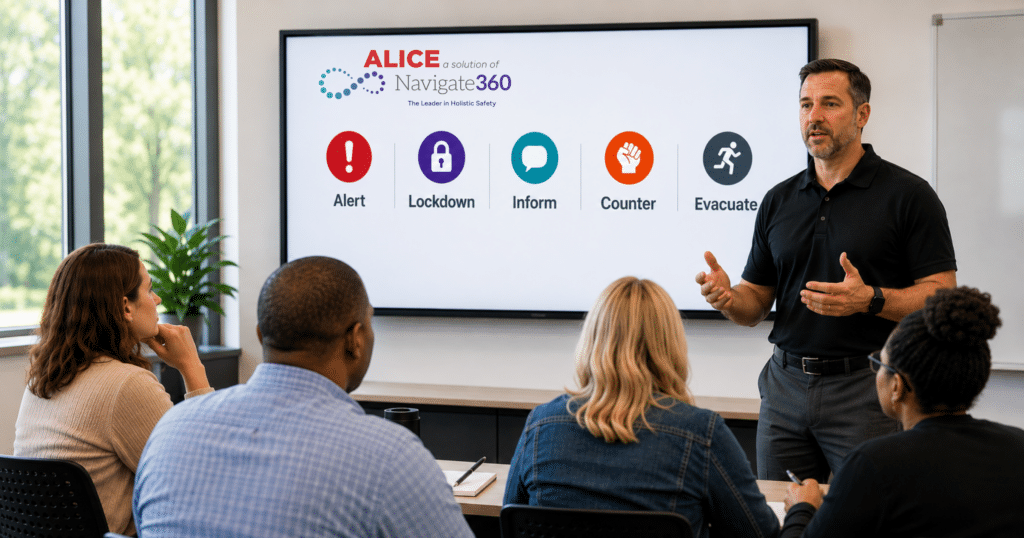
ALICE is an options-based active shooter response training program. These non-sequential response options help people use the information available to them to make decisions as a situation unfolds.
For Arnold, the emphasis on empowering people to participate in their own survival connected directly to the work she had been doing since the shooting.
She explained that she “knew it was what was missing in my quest for trying to make something come out of this horrific situation.”
After completing ALICE online coursework, she attended an Instructor Certification course with two deputies during a Tennessee school resource officer conference. She wanted to bring that same preparation to her staff.
However, taking that step meant confronting her own apprehension. Before attending, she talked with her family about the course.
They questioned whether she was ready, and she was unsure how she would respond. The training she hoped would help others first needed to be something she felt comfortable participating in herself.
Building Confidence Without Relying on Fear
Arnold was the only educator in a room of law enforcement professionals. She described the setting as intimidating. Hunter, who was teaching the course, did not know her history.
After the first day, she approached him to thank him for the way the material had been presented. As Hunter recalled, she explained that she had not known whether she could make it through the class.
She then told him about the colleague she had watched lose his life.
Their conversation gave Hunter a deeper understanding of what attending meant to her. By the following day, Arnold felt comfortable enough to share her experience with the class.
For Hunter, that progression reinforced why a trauma-informed approach to training matters.
Instructors may not know what participants have experienced before entering the room. Training needs to help people engage with difficult material and build confidence without relying on fear.
Arnold had spent years working to protect others while rarely discussing the shooting. During the training experience, she recalled recognizing, “You’ve been trying to do all of this yourself.”
She had found a program that reflected what she wanted to teach—and an environment where she felt comfortable talking about why that work mattered to her.
Later, she asked Hunter whether sharing her story could help others. That question eventually brought her to speaking about her experience publicly during an ALICE event.
Bringing Options Back to the Classroom
Arnold and the two officers began bringing ALICE to employees at schools across the county. Their partnership gave her a way to extend the preparation beyond her own experience and into the classrooms where staff would need to make decisions.
“I don’t work for them. They don’t work for me, but we partner and work together,” she said of the sheriff’s department.
As they trained staff, Arnold asked teachers what they would do during a violent critical incident.
Teachers knew the response they had practiced: turn off the lights, lock the door, move to a designated corner, and remain quiet. Arnold acknowledged that those actions could be appropriate in certain circumstances.
What concerned her was whether they understood what else they could do if the situation required a different response.
“I found that my teachers did not have a toolbox of things,” she said.
Some did not realize they could barricade a door if needed. Others questioned whether they could evacuate without an administrator’s instruction.
One teacher asked, “You mean I can really evacuate even though the principal doesn’t tell me to?”
For Arnold, that question brought the purpose of the training into focus. In the high school shooting she survived, the head principal and two assistant principals had been directly affected by the violence.
“What if your principal is the one that’s out of commission?” she asked.
Her teachers needed to understand the options available to them and feel empowered to use their training when the person they normally turned to could not provide direction.
“You Are the Professional in the Room”
“You are the professional in the room,” she told teachers. “You make that decision based on the information that you have at hand.”
She described educators as nurturers and rule followers. Some needed to hear explicitly that they could make decisions based on the circumstances they faced, including whether evacuation or barricading was appropriate.
That was where ALICE connected with the responsibility Arnold had carried for years. She could give teachers practical response options and help them understand their role in choosing among them.
“And now that they’ve been told that you can make those decisions, and here’s some options for you, they’re more at ease, I think, than they were prior to the training,” she said.
The work she had once carried so privately was reaching others in a concrete way. Teachers were asking questions, learning about possibilities they had not understood were available, and gaining a clearer sense of their ability to act.
For Arnold, that was the purpose behind bringing the program to her schools: helping the people in her care feel more prepared than they had before.
Turn a Commitment to Safety Into the Confidence to Act
Arnold’s commitment to safer schools grew from an experience she never wanted anyone else to face. Through ALICE Training®, she found a way to put that commitment into practice—helping teachers understand their response options and feel empowered to use them.
Her story leaves school leaders with a question: Does your staff know what they can do when an emergency demands a decision?
Download your free guide and explore how ALICE Training® can help your staff prepare to make informed decisions when the people in their care are depending on them.

“In the twenty three years I have been a Police Officer, I have received close to 100 certificates. The ALICE Training I received from you is one of the best courses of instruction I have ever taken.”
About ALICE Training®
For over 20 years, ALICE Active Shooter Response Training has led the way in empowering schools, workplaces, and communities with proactive response strategies to improve safety and save lives.

The ALICE Training® Editorial Team
The ALICE Training® Editorial Team is a passionate group of professionals dedicated to sharing accurate, actionable, and forward‑thinking guidance on active shooter response and overall safety preparedness. Our team draws on diverse expertise in education, law enforcement, emergency management, and technology, giving us a well‑rounded perspective on the challenges schools, workplaces, and communities face every day.
With extensive firsthand experience in implementing the ALICE strategies, conducting safety drills, and integrating proven response protocols, our writers bring practical insight to every piece of content. We collaborate with leading safety experts and trainers to deliver reliable, easy‑to‑understand information that empowers you to build safer, more prepared environments.
Related Posts
-


The Safe Option Can Change in Seconds: What to Do in an Active Shooter Situation
Learn what to do in an active shooter situation, why the safest response can change quickly, and how options-based training helps people assess and adapt.
Read More
-
School Safety Strategies for Catholic Schools
Explore Catholic school safety strategies that strengthen emergency preparedness, improve response training, and build a culture of readiness.
Read More
-
Does ALICE Training® Work? What the Research Says
Does ALICE Training work? See what peer-reviewed research reveals about survival rates, response times, and trauma-informed active shooter training.
Read More


Discover the Freedom of Empowerment
Prepare your people for the worst case scenario with the best possible training. Reach out today for a quote on in-person training sessions, eLearning options or a blend of the two – and discover the freedom of knowing you’ve done everything you could to prevent tragedy.